
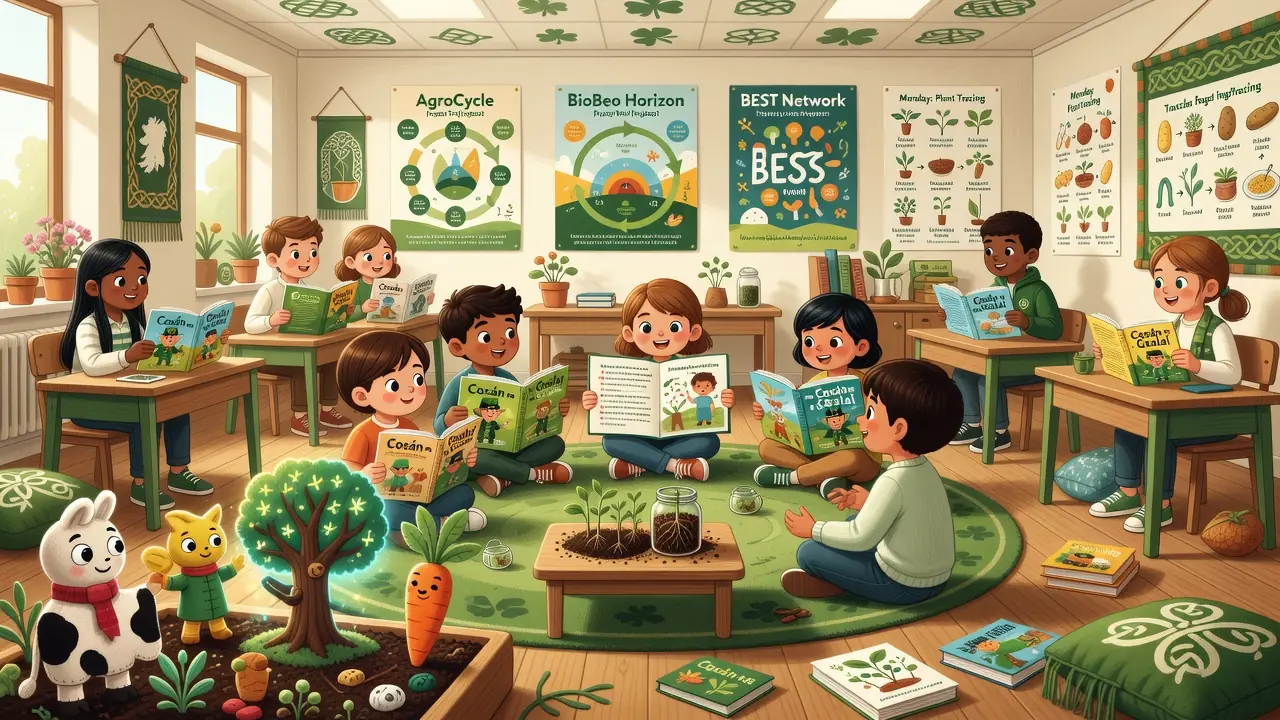
Explaining a complicated economic idea to a seven-year-old takes more than a slide deck. Máire, an education researcher at Maynooth University (MU) in Ireland, has spent years testing how the bioeconomy, the use of crops, forests and organic waste to make food, materials and energy, can be turned into stories, songs, experiments and puppet shows that children can follow.
From farm waste to classroom resources
Her work began with AgroCycle, an €8 million Horizon 2020 research project launched in 2016. The project looked at how agricultural and food waste could be used better, and it brought together scientists, engineers and education researchers. Máire's role was to explain how these ideas could reach children and wider audiences. She says the mix of disciplines was the point: "They're explaining systems thinking to us. We're explaining the educational pedagogies, and it just works."
That collaboration carried into BioBeo, a Horizon Europe project that helps communities understand and take part in the bioeconomy. MU led the primary education work and partnered with European colleagues to produce creative materials for children. Children also helped shape those materials, so their own questions and perspectives influenced the final resources.
A teacher network and weekly classroom activities
BioBeo also helped set up the Bioeconomy Education and Sustainability Teachers (BEST) Network, which now has around 550 members. Its weekly bilingual BESTies resources offer practical classroom activities. Student teachers at MU developed some of them as part of their Irish-language studies, then tried them out in schools during placement. That route gives teachers ready-to-use lessons and gives trainee teachers real classroom experience.
Stories that children can see themselves in
Storytelling runs through much of this work. Máire has worked with colleagues on the 54-book Irish-language Cosán na Gealaí series, which uses engaging stories to explore sustainability alongside Irish language, folklore and heritage. Children were asked what they wanted to see on the page, and their answers shaped characters and illustrations. Máire recalls a child with diabetes recognising her own experience in one picture during a reading session. The moment shows why representation matters in children's books.
Limits and open questions
These projects are research and education efforts, not evidence that a particular teaching method produces lasting changes in behaviour. The available material describes what was developed and how it was shaped, but it does not report long-term outcomes for the children involved. Readers who want to try similar activities at home or in school can look for practical, age-appropriate ideas, such as tracing where a food's ingredients come from, and judge for themselves how well they hold children's interest.